Monday, February 3, 2025

Let Me Introduce Myself


I just started Substack a couple of weeks ago, and I wrote this introduction.  I thought I would share it here.  This is probably the most in depth writing I have done about my artistic life,  It's kind of lengthy.  I'll warn you ahead of time.  

Hello. My name is Mary Ann. I am an artist and linocut printmaker from northern California. I live on the coast, up where the redwood trees grow. It’s a very beautiful part of California. Here I live with my husband, my two cats who are the inspiration for my cat artwork, Hobbs and Oreo, and my wonderful dog Willie. 

Like many artists, I was a creative kid. I loved drawing and painting and crafting. I took art classes in high school, then applied to two great art colleges in New York City, where I grew up, Fashion Institute of Technology and the School of Visual Arts. My parents were not encouraging me to follow an artist’s path, at all. But when I was accepted to both schools, they begrudgingly let me go to Fashion Institute. Alas, my time there was short. Only one semester. I had visited CA the summer before school started and decided I wanted to move there, and I did, six months later.

My first job when I arrived was at an art and frame shop, and it also had the nicest three room gallery in town. I sold art supplies, learned and then did customer framing, and for ten years, I ran the gallery. What an honor that was. I met many of the local artists, chose art for the exhibits, set up the shows and hosted the gallery openings. 

While working that job, I attended a local junior college and took art classes, drawing and painting mainly. That’s when I fell in love with watercolor painting. For twenty years, my main medium was watercolors. I painted regularly, two days a week. I loved it.


I started showing my art in local galleries regularly when I was twenty years old. Pretty much right after I started painting. My paintings started selling right away, and that gave me encouragement to keep following my art path. As my paintings matured, I applied to other galleries within the US, and started showing nationally.


After twenty years, I took a break. My dream of becoming a full-time artist was just not happening. Painting and trying to market my art in two days was frustrating and making me very unhappy. I decided to go get a “regular” job. That regular job just about killed me. In the end, they let me go, and that was the best thing that could have happened. I was free.


While working that “regular” job, I took a couple of jewelry making classes in metal smithing. I started making wire wrapped and beaded jewelry and started selling that on the side. I also started an online gem shop on Etsy, Adornajoy Gems. That was very successful for many years, until more and more sellers started flooding the marketplace.

About seven years ago, I decided to try, for the third time, linocut printing. Inspired by the beautiful artwork I was seeing on Instagram, I thought, why not. The first two times I experimented with linocut, I hated it. Too difficult to get a good print. But I have learned so much since that time. I’m not saying I love it all the time. It is a challenging medium. But more often than not, I am enjoying the process. 


Why cats? I adopted my first cat about twenty years ago. His name was Tiger. He changed my life. Since then we have had three other cats. As an introverted person, I connect to furry creatures more easily than people. I have a home based studio, and they join me there everyday. I feel, I am truly blessed to share my life with these beings. They inspire me, and are the subjects I like to recreate most.

Oh, one last side job. For the last five years, I have been doing consulting and co-instructing workshops on marketing art, or the business side of art, with local artisans through our Small Business Administration. That is a federal government agency that helps start and support small US companies. I love learning about marketing art and sharing what I know. I believe artists deserve to make money, and a living if they so desire, from their creative endeavors.

As for my own linocut art prints, I have mainly focused my attention to showing them online, though I do have a couple of local shops exhibiting them also. I have many international collectors of my linocut cat artwork, thanks to the internet. 

I am truly grateful for all of my followers, and the friends and collectors I have connected with online. I am grateful to be where I am right now in my art career. Thank you for reading my first longer form, blog post today.

Wednesday, August 14, 2024

Printmaker, Nishida Tadashige, and His Influence on My Recent Art

I recently became aware of a Japanese artist whose work I LOVE.  In many ways, it reminds me of my own.  When you look at some of the images below, I think you will see why.  


I could not find a lot of information about the artist.  His woodblock prints are represented in many galleries, but he does not have a website that I could find.  This is what I was able to glean from my research.  

He was born in 1942 on Amami Oshima Island in Kagoshima.  He pursued his studies at Chiba University in Japan, and then later, in the 1960's, traveled to Spain and the US for post-graduate studies in art.  He started out as a painter, but later became a woodblock artist.  He is very well known worldwide for his cat prints, and his landscapes.  Today, he lives in Chiba, Japan.

Here is some of his work.


Something that I like about Tadashinge's cat art is that he will use one cat image he has drawn, and use it in a few different background settings.  And at times, change the color of the cat from black, to a white cat, to a ginger cat. That inspired this last body of linocut art prints that I am currently releasing.  I like this idea so much, I know I will be trying it again in the future.


I hope you liked meeting, in brief, Nishida Tadashige. I'd highly recommend looking him up online just to see more of his beautiful cat art.  If you love cats, I know you will love his work too.   


Tuesday, April 23, 2024

A Date at the Museum

Last Friday, I decided to take an artist's date to see a new exhibit at the Morris Graves Museum.  This is an awesome museum we are fortunate to have in our small community in Eureka, CA.  They have some of the best shows by local and national artists and the exhibits change every month.  

What is an artist date you might ask?  The idea came from a book written by Julia Cameron called The Artist's Way.  Julia describes it as a date where you set aside a block of time, perhaps a couple of hours, to nurture your creative consciousness, your inner artist.  In its most primary form, the artist date is an excursion, a play date that you preplan and do on your own.  This alone time feeds your inner creative self with inspiration.  I know.  I've done this many times.

Examples of artist dates are going to the movies, the theatre, a gallery, or a museum; going to the zoo, the botanical gardens, shopping, or a restaurant.  But it is time you spend alone, not shared with friends or family. 

My favorite artist dates are going to see art in a gallery or the museum.  And it just so happens they are both within a block of one another, as well as a pizza restaurant and an old fashioned handmade chocolate shop.  You know I have to visit them all for the perfect artist date.  :)

This month's exhibit at The Morris Graves Museum was called "Guardians: Spirits of Protection" by Ann Savageau.  


These 15 human sized figures were made of found objects that had washed up on the beach, castoffs as Ann saw it.  The sculptures were created in response to tragic events that happened to Ann and to the pandemic.  


These figures were truly awesome and inspiring to see.  If you are interested you can read more about Ann and her traveling exhibit here.  

Book Recommendation - The Artist's Way

The Artist's Way is a book I highly recommend.  I have read it three times so far, and I'm considering starting it again very soon.


I first became aware of the book, The Artist's Way, many, many years ago and it is still as relevant now as it was when it was first published in 1992.  It was written by Julia Cameron with the help and inspiration of Mark Bryan.  Julia has been writing and teaching workshops and classes based on the principles of this book for decades.  Julia and Mark describe this book as "A Course in Discovering and Recovering Your Creative Self." 

Julia sees everyone as a creative.  She lays out a 12 week program for discovering or recovering one's creative self, with exercises and tools to help get past creative blocks and move forward to living a more creative, fun and fulfilling life.

Your form of creativity may be drawing or painting or any of the arts, it may be singing, writing, acting, gardening, or how you decorate your home. There are so many ways to be creative and Julia's suggestions and tools are helpful for them all.  

Julia considers this book a spiritual path to creativity.  She believes that by connecting with a Greater Source, a Greater Creator, it will help free up your own creativity.  You do not need to believe in a God to have success with the tools in this book.  Just an open mindedness that there is a source of creative energy, outside of yourself, that can help you be more creative.  Here are Julia's basic principles behind the book.


One of the foundations of the book is called Morning Pages.  Julia asks that you journal write three pages, by hand, first thing in the morning when you wake up, before you do anything else.  This is free form, stream of consciousness writing.  Not creative writing.  It's a way of clearing your mind and releasing any critical thoughts, feelings or negativity that may be getting in your way and blocking you from being productive.

Another tool that I highly recommend from the book is the Artist Date.  This is a time you set aside for yourself, to do something you like to do, every week.  You take yourself on a "date." Julia describes it this way: "An artist date is a block of time, perhaps two hours weekly, especially set aside and committed to nurturing your creative consciousness, your inner artist.  In its most primary form, the artist date is an excursion, a play date that you preplan and defend against all interlopers."  I love artist dates.  I have done this numerous times and I have to say, so many times I come home feeling so inspired.  

Examples of artist dates are going to the movies, a theatre, a gallery, or a museum; going to the zoo, the botanical gardens, shopping, or a restaurant.  But it is time you spend alone, not shared with friends or family.  

There is so much wisdom shared in this book.  My review is just a taste of all she has to share. Julia shares inspiration, affirmations, personal stories, ideas, exercises and so much more.   I highly recommend taking a look at this book if you are looking to open up to your own creativity.  


Friday, August 25, 2023

Eight Tips for Starting an Art Collection

Starting your own art collection can be a very fun endeavor.  You don't need thousands of dollars to get started buying art. Everyone can enjoy buying art and starting in an affordable way.  Whether it's a print, painting, photograph, or sculpture, the key is to choose something YOU love and feel good about purchasing.

There are many places to buy art: in galleries, online, at art fairs, festivals, and open studio events.  In a gallery, you will be speaking with someone who represents an artist.  A middle man or woman between you and the artist. Many artists prefer selling their art this way because they can then just focus on creating, while the gallery representative sells their art.  Galleries take a commission for selling art, as much as 50% to 60%, depending on where the gallery is located.  In most cases you can do better buying directly from the artist.

Since Covid, many people have become more comfortable with shopping online, even for art.  Sales for artists increased tremendously, and are still going strong.  Many artists have an online presence, a website and social media accounts, and you can communicate directly with them to find out all kinds of information about them or the artwork. This is a really good place to start researching the artist who's work you are interested in. 

Here are some things to consider when starting an art collection...

1. Follow your gut.  Buy what you like, what appeals to you. You are going to live with it.  Often buying art from an emerging or beginning artist is more affordable, and it can also appreciate in value over time.  Just because an artist is just getting started showing their art does not mean they have not all ready been putting years into learning their craft.  

2. Research an artist whose work you may be interested in.  Check his or her web presence online.  You can find out so much about them from their website and social media accounts.  Or if they are in your local area, visit their studio and talk to them directly.

Showing my linocuts during our North Coast Open Studios

3. Look for artists on Instagram.  Instagram is the best social media platform for seeing artists and their work. Many are self representing, meaning they do not have galleries representing them.  Many artists like representing themselves, they like interacting with their collectors and followers.  I do.  I don't want a middle man or woman representing me.  I think I can speak best about my own art. Instagram is an amazing platform for finding art of all art forms.  If you follow artists there, you can see how they create their artwork as well as get to know who they are and what is important to them.

4. Start small.  You do not need to start with high priced pieces. Works on paper are generally less expensive than works on canvas. By works on paper I mean drawings, various methods of printing, collage work, etc.  Works on paper used to be considered less valuable because they are harder to take care of.  But now with all the high quality papers being made and quality framing materials, that is changing. So start with what you can afford and work your way up as your collection and budget grow.


5. Did I mention framing? Framing choices are very important, especially for works on paper.  I have a blog post written all about the ins and outs of framing.  After all, I used to be a framer in my past life.  Here is a link to that post. 

6. Diversify your collection by purchasing different media.

7. Art makes us emote.  How do you want to feel when you look at a piece of artwork? Do you want to feel good, positive, optimistic?  Do you want it to remind you of someone? A person or beloved pet? Art can be the start of a conversation.  And art can be healing too. But art will definitely make you feel.

8. And lastly, if you are looking to buy art as an investment, do thorough research.  Study an artist's background and career and look for artists whose work has a proven track record of increasing in value over time.


Remember that art collecting should be fun.  It's a personal journey and there are no strict rules.  Trust your instincts, follow your passion, and enjoy the process of building a collection that reflects your unique taste and style.


On Finding Inspiration

The Oxford Language dictionary defines inspiration as "the process of being mentally stimulated to do or feel something, especially creative." 

But where does inspiration come from? I think it's different for everyone. A quote can be inspiring, a good book or a movie, a video or a good speaker.  There are so many different ways to get inspired. That is part of the joy of living.

When I'm looking for inspiration for my next linocut print, normally I look no further than ALL the photographs that I have taken of my cats for the last 10 or so years.  My husband bought me my first digital camera so I could record my cats from the very first one I ever adopted, my cat Tiger.  

The boys, Hobbs and Oreo

And then when the iphone came out, there was no stopping me from taking photos anywhere and everywhere.  I LOVE taking photos.  I take a walk every morning and I often have my phone in hand, photographing pretty flowers in bloom or a friendly cat I see along the way.

Dahlias from the Sequoia Park public gardens

Instagram is another source of inspiration for me.   Instagram started out as a photo sharing social media platform. It seemed quieter then, more peaceful, more subtle.  I started an account 6 or 7 years ago now, and there were no videos at that time.  Videos are good for learning the process of making art, and that is very helpful and inspiring. Most of the accounts I follow are other artists: printmakers, painters and photographers are my favorites.  

Quite often on a Friday afternoon, I go out looking for inspiration.  I take myself out for lunch and go to visit the local art exhibits at a local gallery and museum.  I live in a very active art community in northern CA.  Theatre, dance, music, festivals, we have it all, and many many visual artists. So the art shows here are quite wonderful and inspiring.  My most favorite gallery here is the Morris Graves Museum, which used to be a Carnegie Free Library.  The quality of the exhibits they have are truly amazing.  Just the architecture alone is awe inspiring. I make sure I go every month to see what they have newly displayed.  There is nothing like seeing art in person. 


Inside the Morris Graves Museum

 One more source of inspiration, for me, is nature.  I am fortunate that where I live has MANY beautiful trails and places to visit in nature.  I live on the coast where we have rugged beautiful beaches, peaceful rivers, forests and the redwoods, all close by. Anytime I need a bit of a pick me up, I just get in the car for a short ride and visit one of these beautiful locations. 

The beautiful northern coast of California

Inspiration is everywhere.  Sometimes you have to go out looking for it.  Sometimes it just comes to you. I've had it come to me in the shower, in a dream, and on a walk. You never know when it will strike.  And sometimes you just need to get in the studio and start working before you get that to have that ah ha moment :)

Tuesday, May 2, 2023

The Hug


"The Hug," my latest linocut art print has a bit of a story to it.

Two of my cats inspired this print. The first was Tiger. Tiger is no longer with us, but when he was, he was a cuddly boy. Tiger and I had this thing we would do. I would carry him around the house, which he loved, and we’d end up at our large front window, the one with the tree right outside, and we’d watch the world go by. This was some of my favorite time with him. Now Hobbs, my other cuddly boy, likes to do the very same thing.

I made this print to honor of all the cuddly kitties out there and their Mama guardians who love them. 💕


“The Hug” is 10”x14” in size. I used Caligo Safewash black ink by on thick gorgeous Stonehenge paper. 


Friday, March 10, 2023

Self Care for Artists

Yesterday, as I was cleaning up my room, I came across a journal I had written in years ago.  In it, was my extensive list of self-care ideas, and I thought I would share then with you, just in case they might be helpful for you too. These are ideas to take care of yourself physically and emotionally, and to help lift your spirit.  And many of them are also helpful for breaking through a creative block.

Here we go...

1. Start your day with plenty of time for yourself.  Lots of spaciousness. A slow morning.  This is very nurturing, not starting your day rushed or stressed.

2. Take a break while you are working.  15 minutes every two or three hours.  Especially if the art form you are doing is physically taxing.

3. Drink your favorite warm beverage, coffee, tea, a latte. I find this very nurturing.  

4. Take yourself out for coffee, lunch, a snack.  I like going out for coffee with a good book, my iPad, or a journal to write in.  

5. If you are feeling down, call a supportive friend or family member.  Or Zoom or Face Time them. 

6. Get out an take a walk, ride a bike, roller skate, jog, swim.  You get the idea.  Anything that will move your body and get those endorphins moving.

7. Get out in nature.  Walk in the woods, on the beach, in the park, etc.  I find this helps me tremendously.

8. Write in a journal.  Get out all your thoughts and feelings in a safe place.  You do not need to share this with anyone.  

9. Start a gratitude journal.

10. Eat healthy, nourishing foods.  

11. Try cooking something new.

12.  Read about new hobbies, interests, things you want to learn about to inspire you.

13. Read inspiring, motivational, spiritual books, or listen to audiobooks or podcasts.

14. Watch inspirational videos, movies, TV shows.

15. Take a bath, hot tub, or shower.  Warm water feels so soothing and healing.

16.  Meditate, either with a a guided meditation, or in silence.  

17. Try a new art form.  

18.  Make art just for you.  Don't worry about showing it to an audience.  

19. Play a musical instrument.

20. Dance to your favorite music.

21. Sing.  This is one of my personal favorites.  Always helps lift my spirits.

22. Listen to your favorite music.

23. Repeat positive affirmations.

24. Plant a garden, inside or out.

25. Read a book in your favorite genre.

26. Decorate your home, office or studio space.

27.  Get a facial or give yourself one.

28.  Get a massage.  Or use a massage tool on yourself. This is something I recently discovered.  15 minutes and I am feeling better.

29. Get a manicure and/or pedicure.  Or give yourself one. 

30.  Get a haircut.

31. Dress up.  Even if no one else will see you but yourself or your family,  Put on some jewelry, some makeup.  Feel good about yourself.

32. Get out in the sun.  You know, vitamin D.  Good for you physically and emotionally.

33. Play a game.

34. Surround yourself with positive people who are your cheer leaders. People who believe in you, and your dream.  Let go of toxic, unsupportive people.

35. Have a glass of wine, or your favorite drink at the end of the day. Share it with a friend. 
36. If you believe in a higher power, pray.  Ask for help.  Listen for the answer.

37. Spend time with a pet. They help keep us in the present moment.  And petting one helps reduce stress.  

38. See a counselor, priest, or spiritual advisor.  Sometimes talking to someone who is not a family member or friend, who is totally neutral, is the best person to talk to and get advice from.

39. Go to an art store.  One of my favorites.  I feel like a kid in a candy store when I visit one. And I get inspired.

40. Go to places that will inspire you: museum, galleries, the zoo, an aquarium, the library, a bookstore.

41. Go to a movie or the theatre.

42. Try a new restaurant.  Yum!  Eat something you have never eaten before.


Wednesday, March 8, 2023

My Recent Exploration into Gelli Printing

Back in 2021, I started exploring gel or gelli printing. I had seen many artists online doing this form of printing, and I decided I wanted to try it too. At that time, I spent a week or two printing with plants of all kinds. It was a lot of fun. Ever since, I have wanted to get back to it to learn more about the medium, but I could just never find the time. Until recently. I just gave myself the gift of play and further exploration into this form of printing. 


Gel or gelli printing is a form of mono printing, that uses a flexible gelatin plate to create prints using different textures and layers of color. Paint is rolled on the gelli surface with a brayer, just like you use in linocut printing. Then you place stencils or plants or other textural objects on the gelli plate, and you place your paper on top, and add pressure to the paper with your fingers or a baren. Once you lift off the paper, you have your printed image. 


You can buy or make your own gelatin plate. I have purchase a few sizes of plates from Gel Press that I like. I decided to purchase my plates instead of making them, for now, because they come in this protective plastic packaging, that you can store the plates in. The surface of the gel plate is sticky, and will attract dust and dirt and pet fur and... you name it. Being able to keep the plates surface clean is very important. In the future, I may try to make a plate, just for the heck of it. It seems like a fairly easy, and economical process. 

Gel printing is fairly easy to do. Figuring out what materials work best for a finished print is a bit of a challenge. That takes trial, effort and experimenting. I find that rice paper works well for printing with stencils. It may also work well with botanicals, I just haven't tried that yet. Other paper recommendations are 80 lb. papers, copy paper, economical packs of cardstock and drawing paper. You want a smooth surfaced paper to give you a more solid print.


I used acrylic paints for my prints. There are many brands available. I like the Liquitex and Artist's Loft brands, in tubes. I also tried liquid versions of acrylic paint in squeeze bottles. For me, the paint just was too thin. The tube paint is thicker and more pigmented, which I prefer. 


My goal in this exploration was to create beautiful papers to be used in the collage art I like to make. I mostly used stencils, because there was not a good choice of plants available in the beginning of March. My plan is to do more botanical printing in the summer.  I can tell you, I'm still learning. 

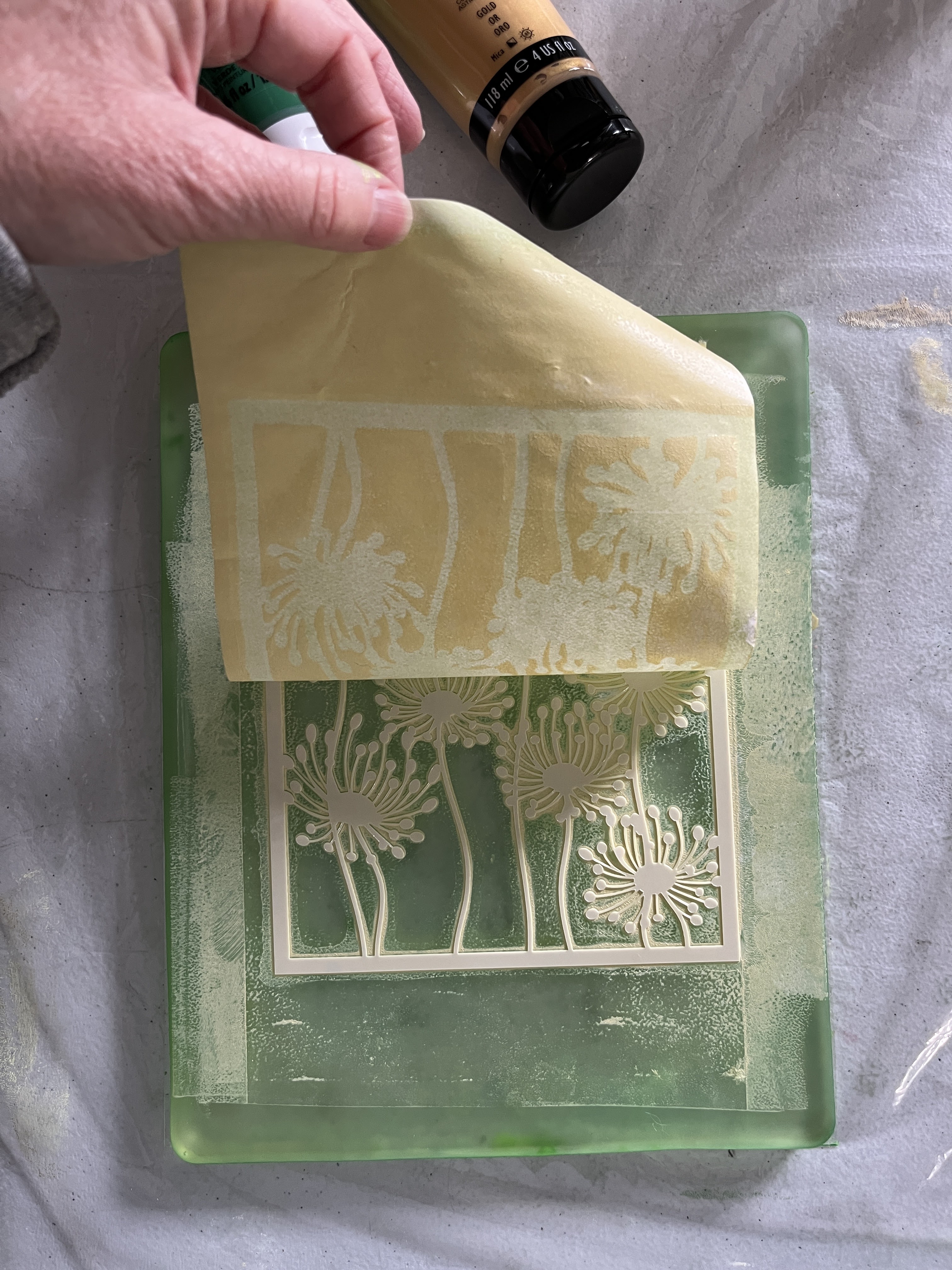
Placing a stencil on the inked plate.

Lifting a print.

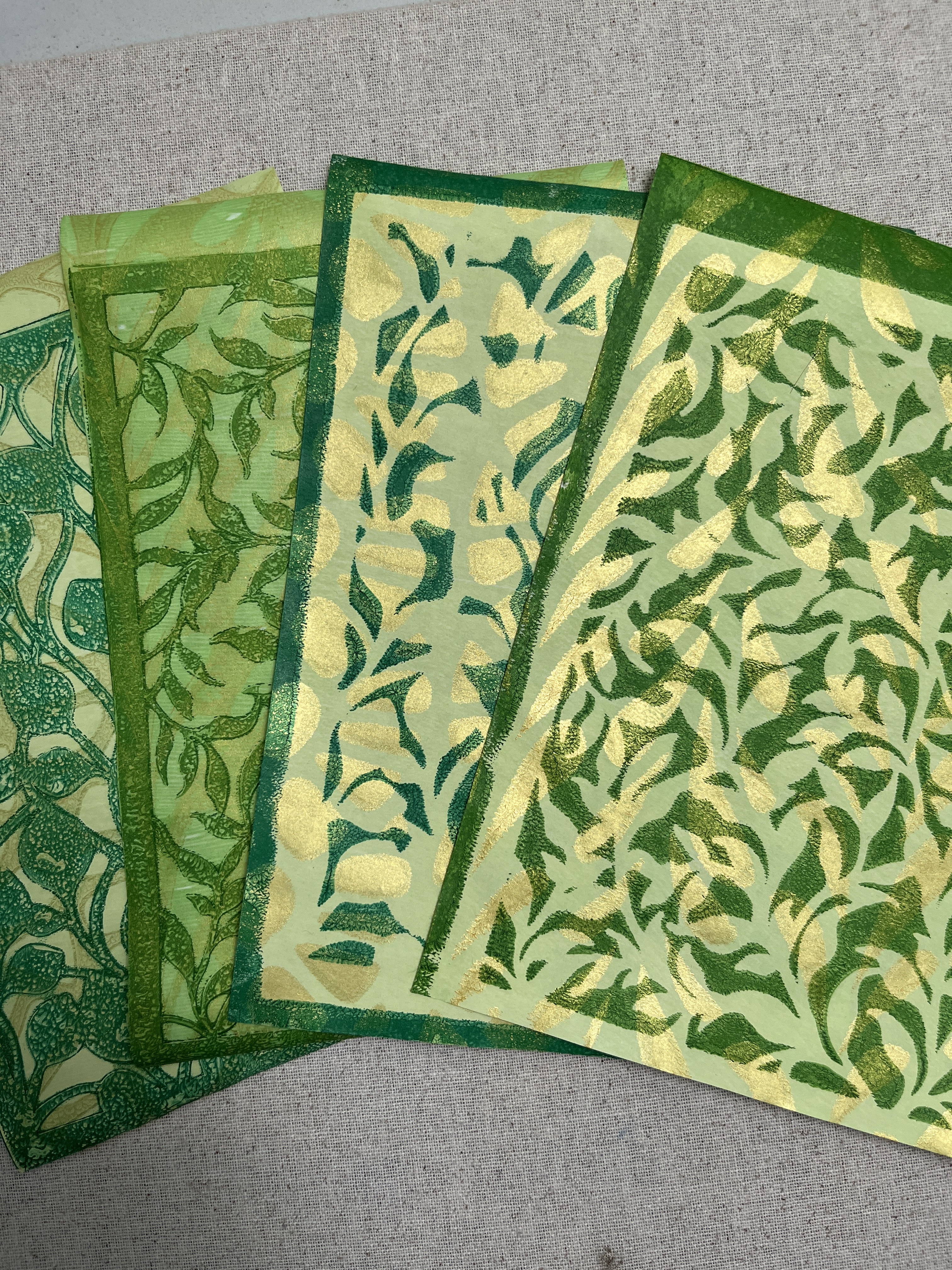
Finished prints using stencils.

Finished prints using plants.

I do have some RESOURCES for you if you are into exploring gel printing too. 

Printers to check out online for botanical printing.  These are people I like.  Most of them are on Instagram, Facebook, and have websites.  The first two artists also have online courses available. 
One printer I know of that prints well with stencils is Elizabeth St. Hilarie of Paper Paintings Collage.  She has written three books on gel printing. She has online workshops available on her website, and you can see her print on You Tube.

Gel Press gel plates are available on Amazon, Blick, and MANY other online art stores, if they are not available locally where you live.

You can find MANY videos on how to make a gel plate on You Tube.

Thursday, February 23, 2023

Self Care - Taking a Retreat Day at Home

Today, quite spontaneously, I decided to take a retreat day at home.  Actually, right in my bedroom.  It is snowing outside, a rare occurrence here on the coast of northern CA.  I am enjoying the beauty I see from my bedroom windows, while being warm and cozy indoors.  And all three of my furry family members have joined me.  Do you see my ginger boy Hobbs in photo?  So far, this retreat is going very well.  

Every good retreat needs to start with a great cup of coffee.  I make a blend of five different flavors of decaf, and some stevia.  And it needs to be in one of my favorite coffee cups.  This is a recent find.  I collect rainbow mugs.  They remind me of my cat Tiger.  


So my plan for today is to get inspired.  To fill up my creative well.  I brought my computer and a notebook, and a collection of art books to read, up to my "bedroom sanctuary." And I have a number of ideas for writing on my blog.  I LOVE to write and just never give myself the time.  Maybe I can change that this year.


My book collection of inspiration for today has a book on block printing, some books on collage, my other love, some art business books, and The Artist's Way. I don't think I will read them all, but bits and pieces of them.  And I'll share the wisdom of what I find in other posts for you.  

So far today is a perfect day.  

Self care is sooo important for artists.  If we don't feed our creative wells, we have nothing to draw from for our creativity.  That's when we experience creative block. I would highly recommend taking a creative home retreat as a way to inspire yourself, and move through creative block, if you are experiencing that.  Or even if you are not.  It's an enriching way to spend a day.    


Tuesday, February 14, 2023

So You Want to Learn Linocut Printing - Recommended Books and Online Resources

 I LOVE art books.  They are my favorite books to collect.  Books are such a wonderful hands on resource.  I know you can look up how to do almost anything online these days, but I still like reading a good book and looking at the pictures.  

I have three good linocut books I would recommend if you are a book lover like me.  

The first just came out in January of 2023.  It's called "Linocut - A Creative Guide to Making Beautiful Prints," by Sam Marshall.  Sam goes over all the tools and materials you will need to create a print, and she has exercises that take you through, step by step, to try different techniques of linocut printing.  There are also five artist interviews of other printmakers and their work.  I highly recommend this book if you are a beginner, or are interested in learning a specific technique that you may not have tried so far.  

You can find Sam on Instagram @sammarshallart.


The other two books I own and would recommend are "Linocut for Artists and Designers" by Nick Morley and Block Print magic by Emily Louise Howard.  They each have their own take on recommended  tools and materials, with projects and sharing of other printmakers work.  

You can find Nick Morley on Instagram @linocutboy, and Emily Howard @thediggingestgirl.

-----------------------------------------------------------------------------------------------------------

If you would rather watch videos on linocut printmaking, check out the following artists on You Tube.  These are artists I would recommend:

  • Maarit Hanninen
  • Laura Boswell
  • Honey Thief Prints
  • E Hollingshead Art
  • Colin Blanchard
  • Daniel Villa Art
Of course, there are many printmakers on Instagram and you can learn so much from following as many as you like, reading their posts and watching their videos.  You can learn sooooo many tips and tricks just doing that.  And many print artists are very generous in answering specific questions if you have some. Please just thank them for their time and generosity in sharing the wisdom they have acquired from lots of trial and error.  

----------------------------------------------------------------------------------------------------------

ONE FINAL AWESOME RESOURCE

This is an addition to my original post.  I had to include it because it truly is so awesome.  If you are on Facebook, you need to join the Facebook group LINOCUT FRIENDS.  It would be worth it to join Facebook just to join this group.  The group is an amazing resource for all linocut printmakers.  Artists share their work, both beginners and more seasoned printmakers, which is wonderful to see.  But you can also get tips and help with questions you have about the process or materials.  I really cannot recommend this group enough.  There are other linocut printmaking groups on facebook that you can join, but this one is truly the best.  

So You Want to Learn Linocut Printing - Here's How I Started

I started linocut printing just over five years ago.  Actually, I had tried it first in a high school art class, and had decided at that time, that I did not like the medium.  I tried it again in my early twenties, and once again, decided it was not for me.  

Five to six years ago I started my first Instagram account for an online gemstone business I had.  I really liked Instagram at that time.  It was all beautiful photos.  Because I am an artist and an art lover, I followed art from artists all around the world.  The art I was most drawn to at the time was linocut printing, and I felt inspired to try again. This time, I stayed with it.

My first linocut

When I started, I didn't want to buy expensive material and tools,  just in case I was not going to stick with it again.  I also didn't want to use oil based ink because I did not want to use toxic solvents for clean up.   

-----------------------------------------------------------------------------------

The tools I started with and would recommend if you just want to try to see if you like the linocut printing are as follows:

1. Speedball has a beginning carving set called the Linoleum Cutter Assortment Kit #1.  It comes with one handle and five changeable gouges or blades.  

2. In order to keep the blades sharp so you do not get frustrated I'd recommend purchasing a Slip Strop by Flexcut.  It is very easy to use.  Just look up a video online.  Dull blades make it difficult to get a smooth carve, and can leave a rough edge to your carve.

The slip strope and carving gouges

3. I started with pink Speedy Carve blocks from Speedball.  They are a soft block material, made of a rubbery substance.  There are other soft blocks available that you may want to try.  This was just readily available to me.

Different block materials I have tried

4. For inks, I started with Speedball water based inks.  I had some that were twenty years old or more and they were still usable, and then I also purchased more.  I also tried the water based printing inks by Blick.  Whatever you buy, you need to but inks specific to linocut or block printing, also called relief printing inks.

Speedball inks, tools and Speedy Carve block

5. Ink rollers.  I started with and still use Speedball rollers.  I prefer the soft, not the hard rollers.

Ink rollers

6. When I first started printing, I did it by hand.  No press.  I also started with a heavy printing paper called Legion Stonehenge.  Not recommended for hand printing.  Light weight papers like rice paper or mulberry paper or anything under 175gsm, would better for hand printing.   Daniel Villa, another linocut artist, recommends Rives BFK 115-175gsm paper, or for a less expensive option, Black Masterprint Paper 75gsm.  A thinner paper requires less pressure to transfer an image, so less wear and tear on your hands.  As far as what to use to press the paper, you can purchase a baren, or use a wooden spoon, a metal spoon, or the glass top from a candle.  

---------------------------------------------------------------------------------------------

I worked in an art supply store for many years when I was in my twenties, which I loved.  I learned so much about the quality of good, expensive art materials.  They are pricy for a reason.  The quality of your art supplies makes a HUGE difference in your finished art piece.  I will say this again because it is soooo important, the quality of your art supplies makes a HUGE difference in your finished art piece.

--------------------------------------------------------------------------------------------

That being said, using the above mentioned supplies were good for me to begin with.  But I could not get the quality that I wanted from my finished prints.  I'm kind of a perfectionist. I knew those materials were not for me.  So I read about what other printmakers were using for inks, paper, and tools, and I bought what I could little by little until I finally know what works best for me now.  Please know, each artist will have tools they like best.  


Here are the tools I now use and recommend: 

1. I like to carve on battleship grey linoleum and Japanese vinyl.  I like the way the printing ink takes to the blocks, and how well the materials print.  I only use the Japanese vinyl when I am doing a multi-colored jigsaw puzzle print.  The vinyl is more expensive, but it stays flat, which is necessary when you are making a puzzle print.

2. I recommend Pfeil and Flexcut carving gouges.  I have only two of the Pfeil gouges, the smallest sizes,  #11 and #12.  Then I have two different sets of the Flexcut tools.  Their SK130 comes with one handle and five interchangeable gouges, and I have their FR804 Micro Palm Set.  Either or both of these sets are wonderful.

Pfeil and Flexcut tools

3. My favorite inks by far are made by Cranfield out of the UK, and they are called Caligo Safewash relief inks.  The colors are vibrant and full of pigment, and they clean up easily with soap and water.  The only oil based ink I use is also made by Cranfield, called Cranfield relief inks, and I only use the metallics in that range.  They are gorgeous.

Caligo Safewash inks

4. I started with and still use Speedball soft ink rollers.

5. Paper.  There is so much to choose from.  I was a watercolor painter for twenty years and with watercolor, the heavier the paper, the flatter it will stay.  With printing, it's not the same.  You don't have to worry about that, but I still like a heavy print paper.  I started out with Legion Stonehenge, and I still use it now.  The paper comes in a beautiful range of neutral tones.  It is 260gsm in weight.  

6. A press.  I tried a number of small presses before I purchased my Woodzilla Press.  I love it.  It has worked very well for me.  But I do know of some artists that cannot make it work for them.  I'm really not sure why.  

Using my Woodzilla press